Featured image: Timnit Gebru, photographed in Palo Alto, California, on 14 September 2026. Photo: Right Livelihood.
On September 30, 2026, Dr. Timnit Gebru was named a laureate of the Right Livelihood Award, often referred to as the “Alternative Nobel Prize”. The jury honored her specifically “for challenging concentrated power in artificial intelligence”. For years, the tech industry has framed conversations about AI around a sanitized, corporate version of “ethics.” Gebru’s recognition strips away that jargon to expose the real issue at the heart of the generative AI boom: who holds the power to build these systems, and who pays the price when they fail.
The Real-World Cost of Algorithmic Bias
To understand Gebru’s impact, it is necessary to distinguish her foundational research from the broader landscape of AI failures.
In 2018, Gebru and Joy Buolamwini published Gender Shades, a landmark study evaluating commercial gender-classification algorithms. They documented severe accuracy disparities, proving that these systems misclassified darker-skinned females at error rates of up to 34.7%, compared to a maximum error rate of 0.8% for lighter-skinned males.
This algorithmic bias extends into other AI applications with devastating, real-world consequences. In separate, widely documented industry failures, automated facial recognition matching systems utilized by law enforcement have led to the wrongful arrests of Black individuals. In 2018, Reuters reported that Amazon had abandoned an experimental recruiting tool that penalised résumés containing ‘women’s’. Gebru’s core argument is that these are not isolated glitches; AI absorbs and automates the prejudices of the concentrated, homogenous power structures building it.
The Google Departure That Changed the Industry
Gebru’s fight for accountability reached a flashpoint in late 2020. As co-lead of Google’s Ethical AI team, she co-authored “On the Dangers of Stochastic Parrots,” a paper highlighting the severe environmental costs and baked-in prejudices of Large Language Models (LLMs).
Google executives requested she retract the paper or remove her name. Gebru refused, outlining conditions for her to remain and stating she would resign at an appropriate time if those conditions were not met. In response, Google immediately revoked her corporate access. The company maintained that it had accepted her resignation; Gebru, backed by a petition signed by thousands of industry professionals, maintained she was fired. The highly publicized dispute laid bare a chilling industry reality: Big Tech’s tolerance for “ethics” research often ends exactly where its product interests begin.
Building Alternatives from the Ground Up
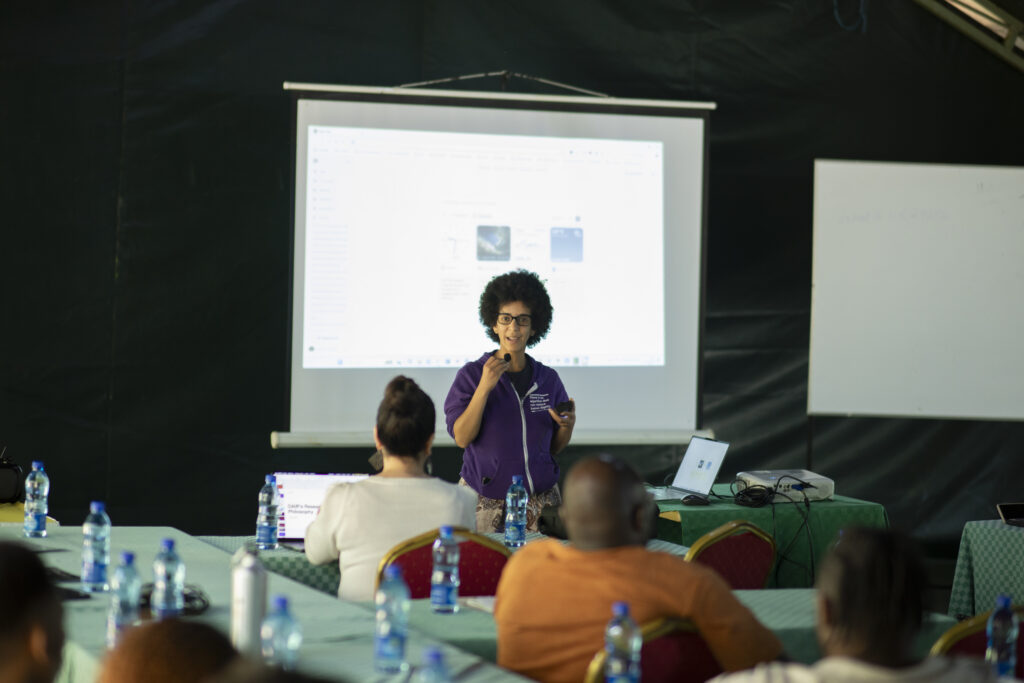
Rather than fighting for a seat at a corporate table, Gebru built a new one. In late 2021, she founded the Distributed AI Research Institute (DAIR), an independent organization designed to operate outside Silicon Valley’s influence. Alongside her earlier work co-founding Black in AI in 2017, DAIR centers the communities most vulnerable to algorithmic harm, proving that technology does not have to be extractive.
The African Context and Global Deployment
For the African continent, Gebru’s framework is vital. The deployment of AI by multinational firms often relies on exploitative practices in the Global South—such as relying on underpaid data labelers in Kenya to filter toxic content for large models—while excluding these communities from governance and product design.
We reached out to DAIR for comment on the Right Livelihood recognition; while representatives were not immediately available prior to publication, Gebru has consistently emphasized in recent public statements that equitable AI requires decentralized development. As one independent African AI governance researcher noted on background for this piece: “The current AI boom often mirrors historical extraction—harvesting cheap labeling labor and data from the continent, while the profits and governance decisions remain locked in California. Gebru’s work provides the blueprint to resist that dynamic.”
The Right Livelihood Award validates what Gebru has argued all along: the most dangerous aspect of artificial intelligence isn’t the code itself. It is the unchecked power of the corporations that control it.