
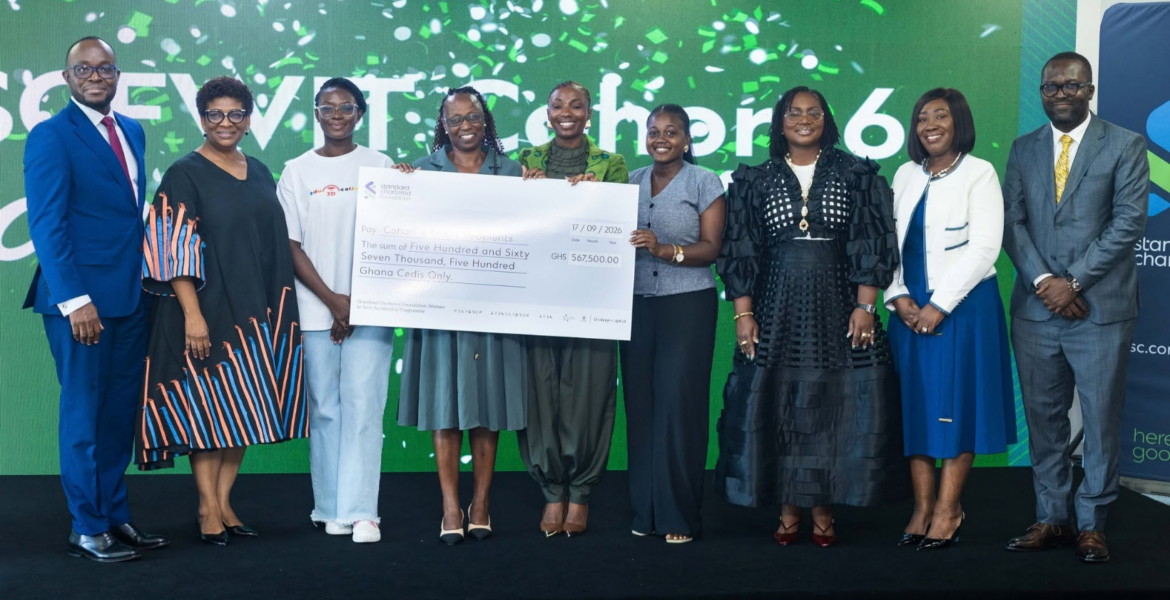
At a time when female-led startups in Africa still capture only a fraction of total venture funding, catalytic grants often serve as the bridge between a good idea and a viable operation. This week, the spotlight turned to the latest cohort of the Ghana Women in Tech Accelerator 2026, where five women-led enterprises emerged from a highly competitive six-month incubation period to secure GH₵113,500 each in growth capital.
The winners, Edu3Dcation Gh Ltd, Wadmet Enterprise, Verte Tower, SisiMarie, and Porducare Enterprise, did not just pitch concepts; they presented operational businesses aiming to address local economic and environmental gaps. The programme, run by the Standard Chartered Foundation in partnership with the Ghana Climate Innovation Centre (GCIC) at Ashesi University, focuses on equipping technology-driven businesses with portfolio management, masterclasses, and networking access.
But beyond the ceremonial cheques and the applause at graduation, a critical question remains for any initiative targeting women entrepreneurs Ghana grants: what exactly is this money building, and how will it move these specific founders to their next operational milestones?
The Mechanics of Scale: What the Winners are Building
Rather than injecting cash into general working capital, the GH₵113,500 grants are explicitly targeted at operational investments—the kind of hardware, machinery, and market expansion that often eludes Ghana female founders due to traditional financing barriers
Verte Tower – Founded by Georgina Yaa Boamah, Verte Tower operates in the AgriTech space, designing modular, hydroponic vertical farming systems for urban and peri-urban environments. According to the venture’s public data, these soil-less, solar-powered systems require 95 percent less water and 90 percent less space than traditional farming. For Boamah, the next milestone is structural. She explained at the pitch event that the GH₵113,500 will fund a critical pivot: transitioning Verte Tower’s production from largely manual assembly to machinery-assisted manufacturing. By integrating AI-supported sensors that track outdoor growing conditions, the business intends to use environmental data to provide precise agricultural recommendations to its users.
Porducare Enterprise – Based in Northern Ghana, Porducare Enterprise, led by founder Portia Dumba, attempts to rework the traditional shea butter value chain. Instead of merely acting as a middleman, the social enterprise trains rural women in sustainable shea butter production and has launched five value-added shea products for local and regional markets. Rather than accepting the “climate-smart” label at face value, Porducare backs its environmental claims with tangible supply-chain interventions, citing the planting and protection of over 3,000 shea and shade trees to combat deforestation. The grant funding will support scaling their processing capabilities to tap into international markets, moving the venture beyond local retail.
Wadmet Enterprise – Wadmet Enterprise focuses on the fast-moving consumer goods (FMCG) sector, specifically through its flagship brand, Mullido. The company produces premium tigernut-based beverages, blending natural tigernut with coconut and coffee. Their operational model prioritizes a zero-waste production cycle. More notably, the venture’s operational framework explicitly integrates opportunities for persons with disabilities, aligning closely with the accelerator’s mandate for inclusive innovation.
Edu3Dcation Gh Ltd – While many EdTech platforms focus strictly on software, Edu3Dcation is targeting the hardware deficit in local education. The company brings 3D visualization, 3D scanning, and 3D design technologies into classrooms, shifting the focus toward practical STEAM (Science, Technology, Engineering, Arts, and Mathematics) and TVET (Technical and Vocational Education and Training) skills. Their focus is bridging the gap between theoretical classroom learning and the applied digital economy. The growth capital is positioned to help deploy these physical technologies into more practical learning environments.
SisiMarie – Led by Creative Director Marie Opoku Adomako, SisiMarie represents the fashion industry’s intersection with sustainable production. The contemporary Ghanaian fashion house blends traditional textile heritage with modern, ready-to-wear designs. Beyond standard retail, the brand attempts to establish circular fashion principles through “Project KAWE,” an initiative providing free maternity wear to rural mothers. The infusion of capital is earmarked to streamline their sustainable production lines and scale their reach.
A frequent criticism of accelerator programmes in Accra is their hyper-concentration in the capital, often leaving out founders operating in more challenging regional markets. The Standard Chartered Women in Tech Ghana initiative made explicit claims this year regarding its geographical and social diversity.
Pearl Esua-Mensah, Executive Director of GCIC, noted that Cohort 6 reached founders from the Upper East, North East, Savannah, and Central regions, and deliberately targeted women living with disabilities. “That mission means nothing if it only reaches those already closest to opportunity,” she remarked during the graduation.
An examination of the cohort provides evidence for these claims. Porducare’s operations are deeply embedded in the Northern regional shea economy, directly engaging rural populations far removed from Accra’s tech hubs. Similarly, Wadmet Enterprise has built disability inclusion directly into its manufacturing workforce. These examples suggest that the inclusion of marginalized groups and regional founders in this cohort goes beyond promotional rhetoric, reflecting actual business models built around these demographics.
The wider context for GCIC women entrepreneurs highlights a persistent gap in the ecosystem: access to finance. Standard Chartered Bank Ghana PLC’s Chief Executive Officer, Xorse Godzi, emphasized that the accelerator is designed to provide catalytic funding and practical business training to overcome these systemic barriers.
The wider context for GCIC women entrepreneurs highlights a persistent gap in the ecosystem: access to finance. Standard Chartered Bank Ghana PLC’s Chief Executive Officer, Xorse Godzi, emphasized that the accelerator is designed to provide catalytic funding and practical business training to overcome these systemic barriers.
According to GCIC’s historical data, the first five cohorts of the programme disbursed a total of $210,000 in grants to 83 women-led businesses. The aggregate impact of those earlier investments includes the creation of 166 jobs, a customer reach exceeding 31,231, and cumulative revenues of GH₵3.9 million. While these figures average out to modest individual revenues, highlighting that these are predominantly micro-to-small enterprises rather than massive scale-ups, they represent crucial survival capital for businesses navigating the difficult early years of operation.
For the climate tech Ghana women emerging from Cohort 6, graduation is simply the beginning of a highly scrutinized growth phase. Guest of honour Theresa Ayoade offered a sobering reminder to the founders about the realities of scale: “The business which stands today may not be the business you are running 10 years from now. Your markets will change. Technology will change”.
The true test for Edu3Dcation, Wadmet, Verte Tower, SisiMarie, and Porducare will be whether the GH₵113,500 serves as a temporary lifeline or a genuine catalyst for industrial scaling.
As for the wider pipeline of female founders seeking similar support, the core selection criteria remain focused on women-led, technology-enabled ventures with a clear socio-economic or environmental value proposition. While GCIC and Standard Chartered have confirmed their ongoing commitment to the ecosystem, application timings and deadlines for Cohort 7 remain unannounced and are expected to be confirmed later this year.